Showing posts with label Food. Show all posts

Tuesday, May 27, 2014

Nutrition in Guatemala: Access vs. Resources

Guatemala is so beautiful - from the rolling hills and lakes, to the vibrant colored, diverse crops sold in the markets. The country seems to have it all. This reminds me how the majority of issues in Guatemala can be due to lack of access, not necessarily resources. 

For example, when I walk through the market, here in Solola, I am amazed at all of the fresh fruits, vegetables, meats, breads, beans, spices, etc that are sold. They are grown here and sold here. So how can Guatemala have such high rates of malnutrition? And this is where I believe the lack of access versus the lack of resources idea comes into play.

It's not that the people lack fruits and vegetables, or other foods that provide necessary nutrients, but instead the people, especially the indigenous people, choose to sell those nutritious crops for more money, instead of keeping them for their own famliies. Nutritionally, fruits and vegetables are not as sustaining as items such as corn and beans. Therefore, families have historically made meals based on more filling foods that lack the nutrients they need. And this has become a part of their culture in the kitchen.

This can be seen in both the meal we had with the family in Tecpan, as well as with the cooking class meal we had in Panajachel last week. Both meals involved a "tamalito" or corn-based dough item. (I found this to be extremely filling.) It is also very typical to have multiple corn tortillas with every meal. Additionally, we had a corn-based soup at our traditional meal in Panajachel. Also typical is Atole, a corn-based hot drink, often served with cookies.

Keeping cultural sensitivity in mind, we must put ourselves in their shoes. Instead of blaming them for choosing unhealthy options, one must consider how tradition has shaped their decisions in the kitchen as well as how the market and poverty continues to shape their choices today.


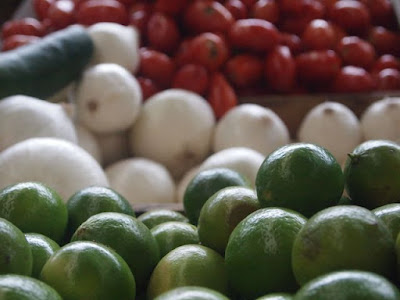
Vegetables for sale at the Sololá market 
- Blair, Visage Student

Sunday, January 13, 2013

Sunday Snapshot: Family Reunion!

I think all of us would agree that visiting my host-family was one of the funner things we did this week.

We shucked corn,

Julie and Sarah excited to be shucking corn!

...But Jess and I were even more excited!

Played with cute kids,

Ja and Mae-Te reading a children's Encyclopedia

Jess and Mae-Te playing outside.

Chippy holding sweet baby Edy.
Then it was my turn with Edy!

And stayed over for some yummy lunch! Tita prepared a chicken soup called pepian that is a typical dish from her region. Julie and I didn't have the soup since we're vegetarians, but we enjoyed the delicious salad and rice... and of course tamalitos. We tried a new sweet fruit for dessert!


I had such a wonderful time seeing them again... and everyone else was able to see why I am so obsessed with this family :) They are so sweet and fun!

-Nicole

Tuesday, August 21, 2012

Bananas

This morning, I was cutting up a banana to put in my bowl of cereal. As I was adding the banana to my cereal, I reflected that the bananas are the perfect size here. There is just enough banana for your cereal and that's it. And I thought to myself, "bananas are so much bigger in the U.S. - what do they do with the extra?"

Hmm, what an interesting thought... what do they do with the extra?

Toto, I don't think we're talking bananas anymore.

Here, we don't really have extra. We buy just enough food to last us a few days, and when we basically have nothing left to eat, we buy some more. All of us packed relatively minimally - we have enough clothes to last us a few weeks, we do laundry, and we're ready to start fresh. We have water for just a few hours per day, yet it's enough for us to get by. If we can't take a shower today, we can try again tomorrow. Even the cell phones we have are pretty primitive: calls and T-9 texting. But it works.

We have enough. (Or perhaps even more than enough, depending on how you look at it.)

But back home in the states, there's so much extra. Extra food, extra clothes, extra water, extra gadgets and apps on our cell phones. What on earth do we do with the extra?!

I don't mean to call out anyone specifically, and I don't want to come across as accusatory to our loyal readers in the states. I just want to reflect on a personal mindset that has changed since I've been down here. I'm realizing that a lot of what I grew up with as normal is seen as "extra" to most of the world. And when this year is over, what am I going to do with that extra?

Just some food for thought. ;)

-Nicole

Wednesday, April 11, 2012

Tortilla Nation

Many people travel the world in search of culinary excellence. Popular destinations include France, Italy, Thailand and Greece, for those who love food and want to try new things. Unfortunately, Guatemala does not make that list. Not even close. Now, this is a personal opinion, so please take it with a grain of salt, but please, read on. Guatemala is “known” for its corn tortillas. These incredibly complex culinary creations involve the delicate mixing of corn with water. Corn + water = corn tortilla. Congratulations, you are now a Guatemalan chef. No, these are not the corn tortillas that your local Mexican restaurant serves. And no, Qdoba and Chipotle do not even use corn tortillas. But I digress. Corn tortillas are the staple of the Guatemalan diet. Whether you are served eggs and beans, grilled meat and green onions or you are lucky enough to receive chopped hot dogs and mayonnaise salad; it will always be accompanied by a corn tortilla. They taste like cardboard. They’re dry enough to make a fish thirsty. They don’t fold well enough to make a nice taco shape, and they are too small to carry much of your meal into your mouth. Guatemala is a beautiful country with warm and receptive people. I have enjoyed pretty much every second of the past 10 months. Come here to explore, go on adventures, learn Spanish, and meet new people. But don’t come here for the food.  

Thursday, May 5, 2011

From the Fields to the Market

“Bananos, bananos, doce por cinco,” exclaimed one of the Mayan women sitting on the ground with her display of assorted fruits gathered around her. She looks at me in desperation, eager to sell me her bananas, afraid that I may visit the other fifty stands in the Sololá market selling the exact same thing. Lucky for her, bananas are exactly what I came here to find, and before I knew it I was negotiating a price for a dozen bananas, and receiving a black plastic bag stuffed with my purchases. Looking up from the hand that had been wrinkled by age and hard work, she flashed me a smile. She seemed pleased with yet another sale.

In Guatemala, fifty percent of the labor force works in agriculture. There are two main geographical regions that account for the majority of the international trade market. Their cash crops include coffee, sugar, bananas, cotton, and cacao (the plant used to produce chocolate). First, the highlands of Guatemala where we live grows primarily coffee and corn. The Highlands region accounts for a huge portion of the country because of the Sierra Madre mountain chain. Here, the majority of Mayan people farm their own land but are expected to give a large portion of their crops to the government for use in international trade. The bigger issue however is that in each generation, the land that a family sustains itself on is parceled up amongst all male offspring, dividing the terrain into smaller and smaller pieces.  This is why you see crops now growing on the sides of steep mountains.  Farmland is consistently being over-used and deforested, not to mention hit by heavy rains that cause landslides making the terrain less crop sustaining in the first place.  Farmers are simply running out of space.
Climbing down from The Highlands on either side of the country lie coastal plains that allow for different farming conditions. Here they grow primarily bananas, sugar cane, and cotton. Recently I learned that 2% of the population on the coast owns 70% of the productive farmland. Private estates, called fincas, owned by wealthy landowners hire laborers to work and live with their families on this land. Fincas are run like tiny villages where everyone living on them rarely if ever leave because they are indebted to the finca owners by means of exploitation. Very little of these crops are used for domestic consumption; most are sold on the world trade market. The rolling tropical plains of the coastal area mean that there is more space, less overuse of farmland, and thus a higher quality of crops. Here it is not the land, but the people that are exploited.

Though, the people of the Highlands region own the land, they are running out of space which has pushed them to the coast to work for wealthy private land owners (multinational food corporations). Because of the immense pressure from the international market that, the rich get richer, and the poor get poorer.  The poor working class needs a break from the government in both regions of the country. In The Highlands, they need some leniency to be allowed to keep more of their crops for themselves and their families, providing greater food security and a more robust economy in domestic markets. As for the coastal area, the government should support small-scale famers by selling small plots of land for reduced price or by compensating laborers more fairly as compared with the land owners they work for.

The end of the war here in Guatemala (in 1996ish) brought a change of ownership of land all over the country because displaced Mayans were never able to regain control of their land.  So today, what little crops they can grow, they sell in the markets like the one I go to in Sololá. As I walk through our market I can only think now of how a little change like acknowledging the labor rights laws or protecting the interests of small farmers would help the people in my community. Passing the numerous stands in the market now bring up questions. How did these bananas get here? Where did they come from? And finally, could I still buy them if I knew they came from exploited hands?

Jared Stepp