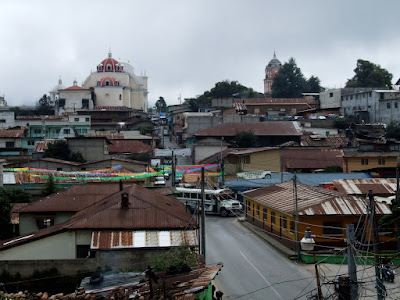
Showing posts with label Sololá. Show all posts

Tuesday, May 27, 2014

Nutrition in Guatemala: Access vs. Resources

Guatemala is so beautiful - from the rolling hills and lakes, to the vibrant colored, diverse crops sold in the markets. The country seems to have it all. This reminds me how the majority of issues in Guatemala can be due to lack of access, not necessarily resources. 

For example, when I walk through the market, here in Solola, I am amazed at all of the fresh fruits, vegetables, meats, breads, beans, spices, etc that are sold. They are grown here and sold here. So how can Guatemala have such high rates of malnutrition? And this is where I believe the lack of access versus the lack of resources idea comes into play.

It's not that the people lack fruits and vegetables, or other foods that provide necessary nutrients, but instead the people, especially the indigenous people, choose to sell those nutritious crops for more money, instead of keeping them for their own famliies. Nutritionally, fruits and vegetables are not as sustaining as items such as corn and beans. Therefore, families have historically made meals based on more filling foods that lack the nutrients they need. And this has become a part of their culture in the kitchen.

This can be seen in both the meal we had with the family in Tecpan, as well as with the cooking class meal we had in Panajachel last week. Both meals involved a "tamalito" or corn-based dough item. (I found this to be extremely filling.) It is also very typical to have multiple corn tortillas with every meal. Additionally, we had a corn-based soup at our traditional meal in Panajachel. Also typical is Atole, a corn-based hot drink, often served with cookies.

Keeping cultural sensitivity in mind, we must put ourselves in their shoes. Instead of blaming them for choosing unhealthy options, one must consider how tradition has shaped their decisions in the kitchen as well as how the market and poverty continues to shape their choices today.


Vegetables for sale at the Sololá market 
- Blair, Visage Student

Tuesday, May 20, 2014

First Impressions


It has already been over a week since I have been in Guatemala and I feel that I’ve already accomplished so much. I have seen so many amazing things and have met and talked to so many people with the most interesting stories. There is not just one thing I could say has been the most influential to me because in reality, every single thing, place and person I see/met is influential.

Summer interns Kalie and Adria making new friends
The children. I could go on and on about their cuteness, playfulness, and just willingness to talk and allow us to be such a part of their day. I’m stoked that they are so interested in learning what this and that means in English. Their smiles and energy just make it that much better and I am grateful for being able to help them in any way I can. 

Entering San Pedro
Just in a short time, I have felt so welcomed by the community we work in (Chaquijya), the community we live in (Solola), the places we visit (San Pedro- which was the greatest weekend trip ever, by the way), and the people of MPI Guatemala this summer. Traveling can be such a powerful experience if you make the very best of it and having these people and places around me make it so much easier to create that. 

- Kalie, MPIG Summer Intern

Thursday, August 9, 2012

Básico Parade in Sololá

Hey everyone! My name is Ja Lee and I will be one of the new Guate Program Directors for the 2012-2013 year! Just a brief intro about myself: I recently graduated this May from the University of North Carolina in Chapel Hill with degrees in Biology and Spanish. Throughout my time in undergrad, I've participated in various trips to Central/South America and fell in love with such experiences because of the insight that I personally gained about the world and myself in the process. Previously, I was a summer intern with MPI at the Ecuador site in 2010 & led an Alternative Spring Break trip down to the Nica site this past March.

It has been whirlwind of adventures ever since we got down here after orientation mid-July!  I personally feel like it has been longer than 3 weeks because of the amount of knowledge we've gained as well as the personal relationships we've fostered with the members of the community we work in. We're slowly but surely settling into our programmatic roles in the community and finding what works and what doesn't, one step at a time. In the process, we've made some great friends in the community, and the exchange of culture and information from both sides has been an amazing learning experience. One big example of this happened just yesterday!

Last Thursday, Nicole and I stayed behind at the school where we teach in Chaquiyá, to observe one of our co-workers, Lydia, teach Social Studies. We thought it'd be a great idea to see what kind of activities motivate these students to learn and do their assignments. Afterwards, all the teachers (including us) were gathered in the principal's office and were just having light conversations. Out of nowhere, one of the teachers, Clara, casually asked if we wanted to be in a parade with them next week. Without hesitation, both of us expressed a very enthusiastic "Sí!" :) She went on to explain that we would be wearing traditional indigenous Mayan clothes ("Trajes típicos") with symbols from the region of Sololá on it. AND that she would lend it to us! True to her word, she brought in trajes for us to try on this Monday. And on Wednesday, we participated in the parade that represented all the Middle/High schools in the surrounding area of Sololá (which was, A LOT more than I'd anticipated!).

Walking in the Parade with the kids from my school!
Although we had a skirt/belt mishap when we tried to put it on ourselves, our students helped us fix it right before the parade! It was an amazing, once in a lifetime experience and I was very honored that they had asked us to participate. Afterwards, we had soda and cookies with the teachers and saw all the other schools with their individual themes. Overall, awesome day!

Nicole & I after the Desfile on our house balcony
Full shot of the traje tipico!
This whole week has been an exciting one in Sololá as it is celebrating its Feria and each day, seems to have new and more interesting events in store. So far, we've seen a concert, various fireworks displays, parades, & carnival rides. Pretty cool.

We have more posts to come regarding our environmental bottle school project, new programs, & new projects in the works! Stay tuned.

Ja

Thursday, May 5, 2011

From the Fields to the Market

“Bananos, bananos, doce por cinco,” exclaimed one of the Mayan women sitting on the ground with her display of assorted fruits gathered around her. She looks at me in desperation, eager to sell me her bananas, afraid that I may visit the other fifty stands in the Sololá market selling the exact same thing. Lucky for her, bananas are exactly what I came here to find, and before I knew it I was negotiating a price for a dozen bananas, and receiving a black plastic bag stuffed with my purchases. Looking up from the hand that had been wrinkled by age and hard work, she flashed me a smile. She seemed pleased with yet another sale.

In Guatemala, fifty percent of the labor force works in agriculture. There are two main geographical regions that account for the majority of the international trade market. Their cash crops include coffee, sugar, bananas, cotton, and cacao (the plant used to produce chocolate). First, the highlands of Guatemala where we live grows primarily coffee and corn. The Highlands region accounts for a huge portion of the country because of the Sierra Madre mountain chain. Here, the majority of Mayan people farm their own land but are expected to give a large portion of their crops to the government for use in international trade. The bigger issue however is that in each generation, the land that a family sustains itself on is parceled up amongst all male offspring, dividing the terrain into smaller and smaller pieces.  This is why you see crops now growing on the sides of steep mountains.  Farmland is consistently being over-used and deforested, not to mention hit by heavy rains that cause landslides making the terrain less crop sustaining in the first place.  Farmers are simply running out of space.

Climbing down from The Highlands on either side of the country lie coastal plains that allow for different farming conditions. Here they grow primarily bananas, sugar cane, and cotton. Recently I learned that 2% of the population on the coast owns 70% of the productive farmland. Private estates, called fincas, owned by wealthy landowners hire laborers to work and live with their families on this land. Fincas are run like tiny villages where everyone living on them rarely if ever leave because they are indebted to the finca owners by means of exploitation. Very little of these crops are used for domestic consumption; most are sold on the world trade market. The rolling tropical plains of the coastal area mean that there is more space, less overuse of farmland, and thus a higher quality of crops. Here it is not the land, but the people that are exploited.

Though, the people of the Highlands region own the land, they are running out of space which has pushed them to the coast to work for wealthy private land owners (multinational food corporations). Because of the immense pressure from the international market that, the rich get richer, and the poor get poorer.  The poor working class needs a break from the government in both regions of the country. In The Highlands, they need some leniency to be allowed to keep more of their crops for themselves and their families, providing greater food security and a more robust economy in domestic markets. As for the coastal area, the government should support small-scale famers by selling small plots of land for reduced price or by compensating laborers more fairly as compared with the land owners they work for.

The end of the war here in Guatemala (in 1996ish) brought a change of ownership of land all over the country because displaced Mayans were never able to regain control of their land.  So today, what little crops they can grow, they sell in the markets like the one I go to in Sololá. As I walk through our market I can only think now of how a little change like acknowledging the labor rights laws or protecting the interests of small farmers would help the people in my community. Passing the numerous stands in the market now bring up questions. How did these bananas get here? Where did they come from? And finally, could I still buy them if I knew they came from exploited hands?

Jared Stepp

Friday, November 12, 2010

A Reflection on Cultural Exchange

The bustling market. A steady stream of public transport buses. Mail and laundry services. Easy access to Panajachel. A soy store that sells delicious strawberry soy ice cream. These are just a few of the reasons for which I find living in Sololá, as opposed to Chaquijyá, to be very convenient. Though I may sometimes joke about the bother of not being able to find chocolate chips here, there’s no doubt that we have it good in this big town, and I am very grateful for that.

On the other hand, one of the greatest compromises that we have made by living in Sololá instead of Chaquijyá, at least initially, is that there is seemingly a limited amount of cultural exchange between us and the people we work alongside. Even though we go to the community several times each week, it is still difficult to appreciate the ups, downs, norms, and daily rhythms of life in Chaquijyá without actually living there. As a group, we have acknowledged this, and last week we were able to verbalize our concern over such narrow exchange with Esteban, the director of La Primaria. Esteban strongly agreed that up to this point, the cultural exchange that has taken place has been somewhat lopsided. For example, he noted that we teach English to students at La Primaria, but we have yet to take any formal lessons to learn Kaqchikel, the indigenous Mayan language spoken by many in Chaquijyá. Similarly, though people in the community have been kind enough to invite us to various celebrations and activities, such as Día de los Muertos festivities and graduation ceremonies, I still feel like our relationship and interactions haven’t delved much below the surface. 

Sharing ideas, beliefs, and aspects of one’s culture generally seems to be easier in an informal and comfortable setting, such as someone’s home. So, in order to facilitate a greater exchange between community members and our group, we are hoping to arrange homestays in Chaquijyá for each of us early next spring. The opportunity to stay in someone’s home provides an avenue through which we can build confianza, or trust, with residents of Chaquijyá and establish relationships that reach beyond our professional interactions. In such an intimate environment, it would be much easier to establish a sincere friendship on which we can ground a cultural exchange.

Such a great opportunity for sharing exists, and I am very excited about the prospect of exploring and nurturing this cultural exchange. Personally, I would love to learn more about Mayan beliefs and rituals, speak enough Kaqchikel to have a two-minute conversation with someone, and develop a better understanding of the cadence of life in Chaquijyá. In return, we, will likely be some of the only foreigners that people in Chaquijyá will meet.  We can expose them to a completely different, less defined, culture and introduce the idea of diversity.  More expressly, because America is such a melting pot of peoples, races, customs, and beliefs, our culture is seemingly less simple to characterize. Even within our group of MPI volunteers here in Guatemala, we represent such varied parts of American culture, as we are from different regions of the country, hold different beliefs, etc.

In the end, despite how different the customs and cultures between us and the people of Chaquijyá are, I believe that we will find commonalities that will enhance our relationship that much more.  For instance, discovering similar or shared family values will improve our bond and, in turn, probably our receptiveness to each other’s culture.  Thankfully, we have several more months to try to overcome any obstacles and really partake in a cultural exchange. I look forward to all that which lies ahead!

Hasta pronto,
Karen

Thursday, September 9, 2010

Perspectives on Life and Death

A beautiful graveside etching.

We arrived in a rush, as usual, after the typical morning struggle to herd all six of us out of the house at once.  One by one, we squeezed our way off of the overcrowded microbus, and before we were able to speak, we were left in a cloud of exhaust as the van scurried off down the Inter-American highway.  We crossed the road, four lanes of sporadic, speeding traffic that spans through all of Central America, only to find that the building where the meeting was to be held was locked and empty. 

“Sí, estoy en mi casa,” was Jesus’s response, on par with the day-to-day confusion to which we have become accustomed, when we called to ask about the meeting.  As head of ASOATITLAN, Chaquijyá’s own community development organization, Jesus is in charge of organizing meetings, and this one had apparently taken place earlier in the morning. In true Guatemalan fashion, ready to change plans at any given moment, we walked the winding road through the community to Jesus’s house, as instructed.

When we got closer, we could see Jesus in his fluorescent yellow button down, waving to welcome us.  After greeting each one of us with a handshake, Jesus began to explain that his uncle was sick.  We were all caught off guard when he then asked us if we wanted to meet him.  Unsure of what to do, we wearily said yes, unable to fathom the awkward silence if we had said no. 

We followed Jesus up a hill to his uncle’s home.  Like most rural Guatemalan houses, this was a row of three rooms, covered in chipped turquoise paint that opened directly to the outside.  Jesus entered the middle room, where the door was already open, and motioned for us to follow.

In the room lay two double beds, one unoccupied but covered in disheveled sheets and blankets, as though someone woke in a rush.  In the other bed lay Jesus’ sleeping uncle, covered to his chin in blankets.  The room was semi-lit with a dull bulb and two small open windows letting smoke in from the kitchen outside.  In contrast with the cold cement floor and walls, faded colored streamers hung from the wooden ceiling beams.  Perched on two plastic chairs in the corner sat a coffin, brand new, made of polished wood and decorated with a painted portrait of Jesus on the front.  A little girl no older than two played by herself underneath it. 

After setting out plastic chairs in the middle of the room for us to sit, Jesus explained that his 64-year-old uncle had a stomach tumor that an operation in Guatemala City had failed to remove.  So there he lay, waiting to die, surrounded by a mix of family members and strangers, next to the coffin where his body would finally be laid to rest.

I couldn’t help but be overwhelmed by the feeling of morbidity, thinking how awful it would be to see your casket at your side, knowing what looming fate awaits you.  Death is not something that we like to acknowledge in American culture.  Death is private.  It is sterile.  It takes place in a hospital room, separate from the rest of the world where life is lived.  There are machines involved, ventilators and respirators and IVs, tools used to cling to life with every last ounce of hope, even when it bears no resemblance to what it once was.

But there, in that room, a man had surrendered.  He had accepted that his final days had come, that he had reached the end of the road.  And nobody was afraid. 

Though we silently squirmed in our plastic chairs, uncomfortable with the closeness of something we’d learned to fear, I couldn’t help but feel the slightest air of peace by the calmness of those around us.  I still sit in awe recollecting on that short-lived but most touching experience, pondering over what it might tell us about life.  Does understanding death help one live?  Are we in the U.S. crippled by the fear of the inevitable?


The rest of our afternoon was spent exploring a faraway part of the community, though a thunderstorm quickly put a damper on our plans.  As we tried to outrun the fast encroaching rainclouds, we found shelter in the homes of strangers.  One woman let us sit in her kitchen while she told us about her children and showed us how to weave traditional Mayan clothing.  Another family of at least 25 people invited us into one small room to watch their band rehearse for their day to play at church.  As sons and fathers and grandfathers drowned out the rain on the tin roof with their powerful music, I realized how beautifully this scene contrasted what we had experienced just hours earlier.

Though I still ponder over the occurrences of that afternoon, trying to derive meaning from two things so seldom experienced side-by-side, I know that we have been implicitly challenged to open our lives, as well.  That day people we had never met welcomed us in to see life, and to see death.  There was no fear or shame, just honest reality.  Perhaps in a life well lived, the two are not so different. 

  Kat

Friday, August 13, 2010

Fully furnished & ready to go...

View from the balcony of our new house :)

              Today is a very special day. Why, you ask? Well, it’s because today marks the end of settling into our new house! After several weeks of searching, negotiating, and nesting, we are finally settled into what will be our home for the next year, and the potential home for future generations of MPI Guatemala’s Program Directors. The house is beautiful and already feels like home. Located at the entrance to Sololá, it has three stories, classy red tile floors, white stucco-ish walls, and rich wood ceilings. Personally, my favorite aspect of the house is the view. From our balcony on the 3rd floor, we overlook our neighbors’ courtyard and corn fields, and we can see the plaza in Sololá. Plus, every room (minus the bathrooms) boasts an incredible view of Lake Atitlán and its three surrounding volcanoes. Truly, I feel as though we are living in a postcard photo. What an amazing opportunity to be able to live and work every day in a location so breathtaking!

Our new, beautifully furnished living room
Ginny in the kitchen (with Dina?)

Another view from our balcony into the heart of Solola.  You can also see the feria streamers!
              Let me tell you though, attaining our house certainly was no easy feat. Finding and furnishing the house required teamwork, persistence, and creativity. In a way, I believe that our housing search was the first significant, Manna-related challenge that our group has successfully faced. Here’s how it all went down…
              Before the other PD’s and I arrived in Guatemala, our two fearless Country Directors Kat and Dana had scoped the area around Chaquijyá for houses and had found two potential options. However, during our stay in San Pedro, we were aggrieved to learn that not only would the construction on one house not be completed in time for our arrival, but also the second option would not be as feasible as we had originally expected. Consequently, the team and I quickly had to devise alternate plans to find a home. In most of Guatemala, most house hunters do not use real estate agents, but instead learn of available homes through their friends and extended families. While we did not have a large social network in place in Sololá, we decided to see if this same system would also work for us.  Thus, following a brilliant idea from Kat, we travelled to Sololá after our morning classes, and divided into groups to post flyers around the city advertising our needs. While posting the flyers, we also met several residents of Sololá and asked them if they knew of any houses for rent.
              As you can guess, the plan was successful! With the help of our flyers and the friendly residents of Sololá, we found four great potential houses during that first afternoon, and now have our beautiful (and feasible) home! Although we encountered some difficulties in installing our stove, water deposit, and washing machine, those obstacles have been tackled and I know we are all so happy with the furnishings and layout of the house. I guess our process is testament to the old phrase: “If at first you don’t succeed, try, try again.” Having overcome our first set of challenges, we begin work in the community with our bags unpacked and our heads held high.

We bought so much from our new friend Trinidad that he threw in a free toaster!

              Throughout our house hunting adventure, the group and I were also fortunate to receive visits from two of the founding Program Directors for MPI Ecuador. Currently a Spanish teacher in Oakland, California and all-around baller, Craig Smith visited and stayed with us in San Pedro for a week. Besides joining us on our sunrise hike up the Indian’s Nose and many social activities, Craig also greatly helped us as we negotiated with landlords and met to choose the best of the four housing options. Two weeks later, a current MPI Board Member, Zak Schwarzman joined us to celebrate moving in to the new house. Together with his hysterical girlfriend Briget, Zak took us down in several rounds of the Ecuadorian card game Cuarenta, but we've been practicing and are ready for a rematch. Overall, our time with Zak, Craig, and Bridget was fun and beneficial for our group. Not only did they share some great stories from their experiences in Ecuador, but they also imparted useful and thought-provoking advice, and gave our group a clearer picture of the mission of Manna Project as an organization.

Cuarenta with Zak in our living room... before it was furnished.
               Recently, after meeting Zak and Craig, it occurred to me that everyone I have met from MPI, every board member, every Country Director, and all the past and current Program Directors have amazed me with their intelligence, dedication, and overall spunky personalities. I feel so incredibly lucky to be part of an organization filled with such amazing individuals. I know that by working together with MPI past, present, and future, we can make a difference; and I cannot wait to see how the year progresses for all three sites and for Manna Project as a whole.

Ginny

Friday, August 6, 2010

Yo no se manana


¡Bienvenidos from MPI Guatemala’s new house in Sololá!


Our first attempt at a group photo from our balcony
     During the past three weeks, my fellow PD’s and I have been living, learning, and experiencing San Pedro La Laguna, an incredibly picturesque Tz’utujil and hippie-tourist town located on the world famous Lake Atitlan. Not only were we able to take intensive Spanish classes every morning, but we also soaked up Maya culture firsthand. Our classes were held at the San Pedro Spanish School, which provided an enjoyable (and much needed) recap of Spanish. Working one-on-one with an instructor, each of us significantly improved our conversation skills and developed close relationships with our teachers. (Please note: the Gringa girls still remain undefeated in the student vs. teacher weekly fútbol games.) All of us were sad to leave the school, but I am confident that we will visit often throughout the year. Plus, for our farewell graduation “speech,” the six of us changed the lyrics to Luis Enrique’s “Yo no sé mañana, and performed it in front of the whole school.
Our graduation song presentation
            While taking classes, each of us stayed with host families that lived near the school.  All of our families were welcoming and friendly. My host parents not only owned a laundromat and a restaurant (so the food was great), but they also used to work as tour guides. Listening to their abundance of stories about Maya legends and traditions, I received an amazing first taste of the local culture in the Guatemalan highlands, and grew even more excited to work in Chaquijyá for the upcoming year.
            For the afternoons and weekends, we spent our time exploring the natural beauty of San Pedro with an eclectic assortment of fellow travelers local residents. Between scaling the Indian Nose mountain to see the sunrise, bathing in solar pools, horseback riding, attending salsa lessons, kayaking to the neighboring organic town of San Marcos, and learning to make paper lanterns, we all kept ourselves quite occupied.  My favorite excursion was our visit to the annual Feria held in Santiago Atitlán.  Just a brief lancha (boat taxi) ride from San Pedro, Santiago experienced numerous tragedies during the brutal 30 year Civil War.  Because of the atrocities committed during the Civil War, the government now forbids the military from entering the town.
An array of onlookers as Jared tries his hand at one of the games at Feria
            I am continuously amazed by the outlook of the Maya peoples despite the recent tragedies. Practically every Maya alive today lost family members and fled their homes, yet these same people are the most generous, amicable, and positive people I have ever met. An interesting fact, despite the lingering horrors of the war, Guatemala ranks #4 on the New Economics Foundation’s Happy Planet Index. Hearing the stories of the local people and observing daily life, I'm inspired by their resilience, and I am filled with awe at the Maya’s ability to maintain their traditions in the face of discrimination and violence. Although we will be leading various classes in the Maya community of Chaquijyá, more importantly, this year will be a cultural exchange and learning opportunity for us both.
            For me, the past three weeks have provided the perfect transition to our new life and work in Sololá and Chaquijyá. Not only have we been able to come together as a group and improve our Spanish, but our time in San Pedro has also allowed us to better acclimate to a new lifestyle and society. Now, as we nest in our house and begin to discuss our programs and positions, my excitement for the upcoming year continues to swell, and I am even more grateful for the opportunities and lessons we have been given throughout the past few weeks.
Relaxing at the top of Indian Nose Moutain

Ginny Savage & the MPIG team

Monday, March 15, 2010

Gettin' better all the time...

Since we decided to focus our efforts solely on Chaquijyá, we've been spending the majority of our time in Sololá due to the proximity.  Our site lies only about 30 minutes northwest of Sololá.  Great news in terms of hospital access, grocery needs, etc.  This week we met with various people who helped us out on the logistical side.. finding a house, safety precautions, cultural sensitivity specific to our community, etc.  Amidst our meetings, Maddie and I dipped out to Panajachel and took a romantic boat ride around Lago Atitlan so people would stop gasping when we said we hadn't been there yet.

Told you it was pretty...

Miss you Maddie!

Maddie left us this past Saturday to start grad school in a few months.  I wonder if she's still reading..

Anyway, when we went to meet with Jesus again on Sunday, it turns out he had really invited us to his cousin's wedding (?).. so although we were under-dressed, it was a great time and great chance to meet some more community members.  Jesus has surpassed my expectations with every meeting we have with him, and I am so excited to work with him in the future.  If that wasn't good enough, this morning we attended a community leader meeting with the school director, mayor, various project teams, teachers, and local development organization. Turns out this community breeds organized, proactive members of society.  They were all so welcoming and cautiously optimistic of us.  In my eyes cautious optimism is even a step better than complete excitement- it shows thought and consideration of the pros and cons of our presence, and makes me feel like they don't see dollar signs in my American face.  It really makes me want to work for their acceptance and trust.

One week left, but much more to come,

Dana


Friday, March 5, 2010

Guatemala welcomes Hillary Clinton today!

Well yes, we ended up returning to Xela sooner than we thought, but not for long..

We spent this morning in the Aldea of Tierra Blanca in San Bartolo Aguas Calientes.  Guess who it came highly recommended to us by?  You´d be right if you were thinking another Peace Corps friend!  But you´d be wrong if you thought anyone besides Kiki. 

Chris, Maddie, and Kiki looking like they´re ready to settle down.

Our meeting with the community leaders went very well, but the best part was the interjection by a Health Technician named Vicky.  Noticing their hesitation after our presentation, she quickly and concisely summarized Manna´s goals, vision, and programs perfectly.  She even underlined our focus on giving through education rather than via check.  We asked her to follow us to the rest of our meetings, but she thought we were joking... we weren´t.

Tierra Blanca has been added to my list of possibilities.  Thanks for your help Kiki and Vicky!

Now we are in Sololá, well actually 10 minutes away in nearby Panajachel.  Tomorrow morning we will meet with a few representatives from the University of the Valley, including the director of projects.  Hopefully she works in fields as broad as her title implies.  From one meeting to the next, we will jump to Jesús Toc who runs his own NGO, Asoatitlan.  He also works on a wide variety of projects in the education and environmental sectors, and has answered all of our emails within the hour.

Just in case anyone is keeping track... possible future Manna sites now include:

1. Toj Mech
2. Tierra Blanca
3. Sololá
4. San Vicente Buenabaj

 Happy Friday, watch your head on the way out, Dana

Sunday, February 28, 2010

Plan of action

As the days wind down we are trying to stay on top of all our options and keep you posted as well.

After visiting countless communities and meeting with non-governmental organizations all around the western highlands, we´ve been circling four main areas or communities.

In no particular order,
1. Toj Mech
2. Momostenango
3. San Vicente Buenabaj
4. Sololá

There are various reasons for our elevated interest in all four, but as a group they represent the contents of most of my thought bubbles.  Over the next two weeks we will be buckling down and exploring the actual feasibility of a Manna presence in each of these 4 sites.

Enjoy your lazy Sunday, Dana

Saturday, February 20, 2010

Two birds with one stone (or cement block in this case)

Finally Friday, and another round of stove building.  I went to Llano de Pinal, the biggest of the 10 communities that Primeros Pasos serves, and this time I got to start from stage 1!

Stage 1 consists of measuring and leveling until you just can´t do it anymore. If the oil in the frying pan runs to one side, you can always blame whoever built stage 1.

Literally building a stove from the ground up!

When I heard that Pop Wuj´s stove builders worked with Llano de Pinal I jumped at the chance to both build and investigate the community more closely.  There are 2,000 children that live within the community limits alone!  Good thing the government sent funding their way and a brand new school was built just last year.  I also got to visit the only kindergarten in the whole community.  I´m not sure where all the kids are, because there were only 20 in the class...

The brand new Basico school in Llano, with a separate building for adult education, a soccer field, and a women´s education wing!


Our completed stage 1 stove-- all level and ready to cook hundreds of tortillas.


The very sweet family who are now the proud owners of a stage 1 stove!

Maddie couldn´t come build this time because she was attending a general meeting with nearby peace corps volunteers, including our friend from San Vicente Buenabaj.  Maddie made a lot of great contacts, and for starters, we will be visiting one volunteer in her community outside of Sololá.

That will just about wrap up the week, but Sunday brings the most exciting news of all!  CHRIS TAYLOR AND LORI SCHARFFENBERG ARRIVE!  For a full week, Maddie and I will have the pleasure of showing them around the wonder that is Xela.  We are so excited to have them, because let´s be honest, we wouldn´t be here without them.

Thanks for reading,

Dana